Emir of Kano Biography: Life, Reign and Legacy of Muhammadu Sanusi II

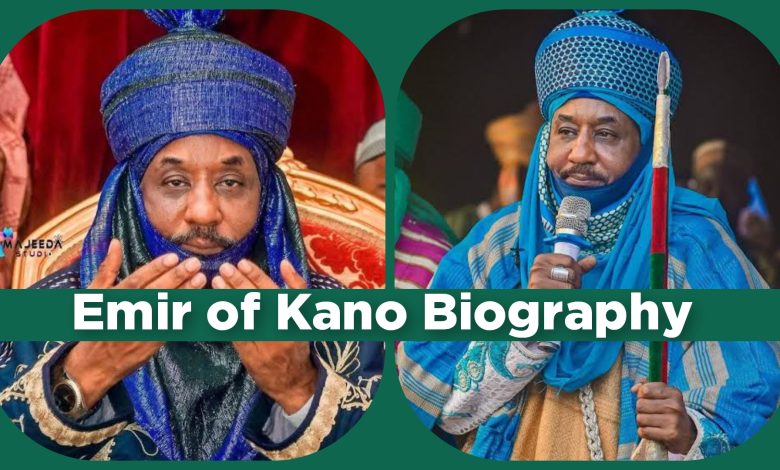
Muhammadu Sanusi II, known by his regnal name and also as Sanusi Lamido Sanusi, stands as the traditional ruler of the historic Kano Emirate in northern Nigeria. Born into a prominent Fulani royal family, he has combined a distinguished career in banking and public finance with leadership of one of Nigeria’s most influential traditional institutions. His story reflects the evolving place of traditional authority within a modern federal republic.
Muhammadu Sanusi II Early Life and Family Background in Kano State
Muhammadu Sanusi II was born on 31 July 1961 in Kano, then part of the Northern Region of Nigeria. He belongs to the Sullubawa clan of the Fulani people and is a member of the Dabo dynasty that has supplied most rulers of Kano since the early nineteenth century. His father, Aminu Sanusi, held the traditional title of Chiroma of Kano and served as a career diplomat, including postings as ambassador to Belgium, China and Canada, and later as Permanent Secretary in the Ministry of Foreign Affairs. His mother was Saudatu Hussain.
Kano State, located in the north-west geopolitical zone of Nigeria, is one of the country’s most populous and historically significant states. Its capital, the city of Kano, has been a major commercial and cultural centre for centuries, situated at the crossroads of trans-Saharan trade routes. The region’s landscape includes the ancient city walls, Dala Hill, and fertile agricultural lands that have long supported trade in textiles, leather and grains. The emirate itself traces its origins to the Hausa kingdom established around 999 AD under the Bagauda dynasty. In the early nineteenth century the Fulani jihad led by Usman dan Fodio transformed the kingdom into an emirate within the Sokoto Caliphate. Ibrahim Dabo founded the present ruling dynasty in 1819.
Sanusi grew up largely in the royal palace of his great-uncle, Emir Ado Bayero, who reigned from 1963 until 2014. This environment exposed him from an early age to both the ceremonial life of the emirate and the responsibilities of traditional leadership. His grandfather, Muhammadu Sanusi I, had ruled as Emir from 1953 until his deposition in 1963, providing a direct familial link to the institution Sanusi would later lead.
Muhammadu Sanusi II Education and Intellectual Formation
Early religious instruction at home covered the Qur’an, Hadith and Islamic traditions. He attended St. Anne’s Primary School, a Catholic boarding school in Kaduna, before proceeding to King’s College, Lagos, for secondary education between 1973 and 1977.
He earned a bachelor’s degree in Economics from Ahmadu Bello University, Zaria, in 1981, followed by a master’s degree in the same field in 1983. He lectured briefly at the university. Later he studied Islamic law and related subjects at the International University of Africa in Khartoum, Sudan, becoming fluent in Arabic and gaining exposure to the major Sunni schools of jurisprudence. In 2024 he completed a PhD in Islamic law at the School of Oriental and African Studies, University of London. His thesis examined the codification of Islamic family law as a tool for social reform, using Kano as a case study and drawing comparisons with Morocco.
Muhammadu Sanusi II Career
His professional path began in banking and later moved into high-level public service.
Banking Experience
In 1985 Sanusi joined Icon Limited, a merchant banking firm linked to Barings Bank and Morgan Guaranty Trust. He advanced to head of financial services and managed the Kano office. After a period of further study in Sudan he returned to Nigeria and joined the United Bank for Africa, rising to general manager in credit and risk management. In 2005 he moved to First Bank of Nigeria as executive director responsible for risk management. By January 2009 he had become the bank’s group managing director, the first northerner to hold that position.
Service as Governor of the Central Bank of Nigeria
In June 2009 President Umaru Musa Yar’Adua appointed him Governor of the Central Bank of Nigeria. He served until February 2014. During his tenure he oversaw significant reforms aimed at stabilising the banking sector after the global financial crisis. These included recapitalisation measures, removal of underperforming bank executives, introduction of a cashless policy, and support for the establishment of Islamic banking. He also publicly raised concerns about large unremitted oil revenues, an action that contributed to the end of his term when President Goodluck Jonathan suspended him in 2014.
The banking reforms earned international recognition, including the Central Bank Governor of the Year award from The Banker magazine.
Muhammadu Sanusi II First Reign as Emir of Kano
Following the death of Emir Ado Bayero on 6 June 2014, the kingmakers selected Sanusi as the new Emir. He assumed the regnal name Muhammadu Sanusi II and was installed on 8 June 2014. His selection was not without controversy, as some expected a direct son of the late Emir to succeed.
During the first reign he advocated educational reform, especially for girls, spoke against certain social practices he regarded as harmful, and supported cultural initiatives including the preservation of traditional crafts such as the dye pits at Kofar Mata. He also oversaw the drafting of a new Muslim family law code and the development of a large public library. In 2019 the Kano State government under Governor Abdullahi Umar Ganduje created four additional emirates, reducing the territorial scope of the original Kano Emirate. On 9 March 2020 the same administration dethroned him, citing insubordination and other allegations. He was succeeded by his cousin Aminu Ado Bayero.
Muhammadu Sanusi II Years Away from the Throne and Return
After deposition Sanusi lived outside the main palace and pursued further academic work, culminating in the 2024 doctorate. On 23 May 2024 Governor Abba Kabir Yusuf of Kano State reinstated him as Emir following the repeal of the law that had created the additional emirates. The reinstatement restored the pre-2019 boundaries of the emirate. As of 2026 the matter remains the subject of legal proceedings, with rival claims continuing and the Supreme Court process ongoing.
Muhammadu Sanusi II Religious Role and Cultural Leadership
Beyond the temporal title of Emir, Sanusi holds the position of Khalifa of the Tijaniyyah Sufi order in Nigeria and neighbouring areas. This role places him among the senior Muslim traditional leaders in the country, second in some rankings only to the Sultan of Sokoto. He has used the platform to promote education, economic participation and measured social reform while remaining rooted in Islamic scholarship.
Muhammadu Sanusi II Awards and Recognition
During his time as Central Bank Governor he received the Central Bank Governor of the Year award (global and Africa) from The Banker magazine in 2011. He was also named Forbes Africa Person of the Year in 2011. Additional recognition has included honorary doctorates from several Nigerian universities and the national honour of Commander of the Order of the Niger. These awards reflect both his financial-sector reforms and his broader public profile.
Muhammadu Sanusi II Personal Life
He is married and has several children. Public records note marriages to Sadiya Ado Bayero, Maryam, Rakiya, and Sa’adatu Mustafa Barkindo. Family members continue to hold traditional titles within the emirate structure.
Conclusion
Muhammadu Sanusi II’s life illustrates the intersection of royal tradition, modern professional achievement and religious authority in contemporary Nigeria. From his birth in Kano in 1961 through a successful banking career, two periods as Emir, and continued scholarly work, he has remained a prominent figure whose actions and statements attract national attention. The ongoing legal and political questions surrounding the emirship underscore the continuing relevance of traditional institutions within Nigeria’s democratic framework. Readers interested in the history of the Kano Emirate or the role of traditional rulers will find in his biography a clear example of how these institutions adapt while preserving continuity.
FAQs
Who is the current Emir of Kano?
As of the most recent verified information in 2026, Muhammadu Sanusi II holds the position of Emir of Kano following his reinstatement in May 2024, although rival claims by Aminu Ado Bayero continue and legal processes remain active.
When was Muhammadu Sanusi II born?
He was born on 31 July 1961 in Kano, Nigeria.
Why was Muhammadu Sanusi II removed as Emir in 2020?
The Kano State government under Governor Abdullahi Umar Ganduje cited insubordination and related allegations when it dethroned him on 9 March 2020. The decision followed years of public differences and the earlier creation of additional emirates that reduced the original territory.
What is the historical background of the Kano Emirate?
The emirate evolved from an ancient Hausa kingdom founded around 999 AD. After the Fulani jihad of the early nineteenth century it became part of the Sokoto Caliphate under the Dabo dynasty, which continues to provide most of its rulers.
What is Muhammadu Sanusi II’s educational background?
He holds degrees in Economics from Ahmadu Bello University, studied Islamic law in Sudan, and completed a PhD in Islamic law at the University of London in 2024.