
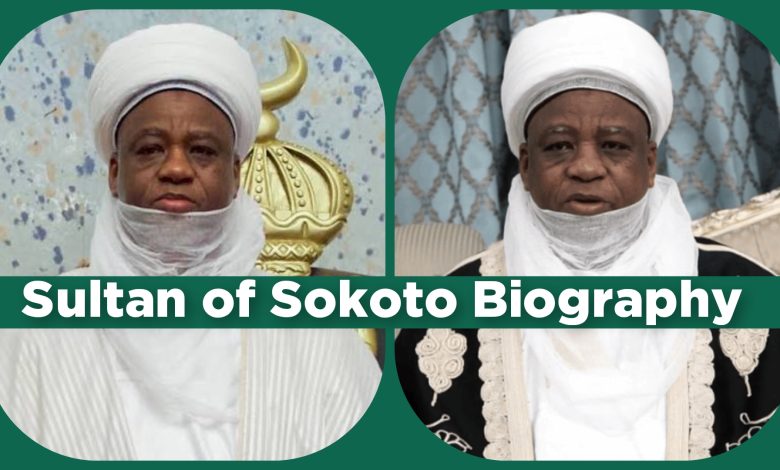
Muhammadu Sa’ad Abubakar III is the current Sultan of Sokoto and the spiritual leader of Muslims across Nigeria. Born into the royal house that traces its roots to the founder of the Sokoto Caliphate, he brings a unique blend of military discipline and traditional authority to one of the most respected positions in West African Islamic history.
Muhammadu Sa’ad Abubakar Early Life and Family Background
Muhammadu Sa’ad Abubakar was born on 24 August 1956 in Sokoto, in what was then the Northern Region of British Nigeria. He is the youngest son of Sir Siddiq Abubakar III, the 17th Sultan of Sokoto, who reigned from 1938 until his death in 1988 and remains the longest serving holder of the title.
Sokoto State is the historic heartland of the Sokoto Caliphate. The city and surrounding region carry deep cultural and religious significance for the Hausa and Fulani peoples of northern Nigeria. The Sultanate itself descends from the scholarly and reformist tradition established by Sheikh Usman dan Fodio in the early nineteenth century. Usman dan Fodio, a Fulani scholar of the Torodbe lineage, launched a movement that sought to purify Islamic practice and establish just governance across the Hausa states. His son Muhammed Bello became the first to bear the title of Sultan, and subsequent rulers have continued that line.
Growing up in this environment, Sa’ad Abubakar received both Islamic instruction and formal Western education. He attended Sultan’s Ward Primary School in Sokoto before proceeding to Barewa College in Zaria, one of the most respected secondary schools in northern Nigeria. The college has produced many of the region’s military, political, and administrative leaders. His early years combined the expectations of royal responsibility with the practical training that would later shape his public service.
Muhammadu Sa’ad Abubakar Military Career
After completing secondary education, Sa’ad Abubakar entered the Nigerian Defence Academy in 1975 as a member of the 18th Regular Course. He was commissioned as a Second Lieutenant in 1977 and joined the elite Armoured Corps of the Nigerian Army.
His military service spanned nearly three decades and included both domestic command roles and international assignments. In the early 1980s he commanded a battalion of African peacekeepers in Chad as part of an Organisation of African Unity force. In the late 1980s he led a presidential security unit of the Armoured Corps that protected then military ruler General Ibrahim Babangida.
Service with ECOWAS and ECOMOG
From 1995 to 1999 Sa’ad Abubakar served as a military liaison officer for the Economic Community of West African States. He later commanded the 231 Tank Battalion during ECOMOG operations in Sierra Leone between 1999 and 2000, a period marked by intense conflict in the sub region.
Defence Attaché and Final Rank
Between 2003 and 2006 he served as Nigeria’s Defence Attaché to Pakistan, with concurrent accreditation to Iraq, Saudi Arabia, Afghanistan and other Gulf states. This diplomatic posting gave him extensive exposure to international security and inter faith issues. He retired from the army in 2006 with the rank of Brigadier General after more than thirty years of service.
The discipline, organisational skill and calm under pressure that characterised his military career later became assets in his traditional and religious leadership.
Muhammadu Sa’ad Abubakar Ascension to the Throne
On 29 October 2006, Sultan Muhammadu Maccido, Sa’ad Abubakar’s elder brother and the 19th Sultan, died in the crash of ADC Airlines Flight 53 near Abuja. The tragedy claimed many lives, including members of the royal family.
Kingmakers of the Sokoto Sultanate selected Sa’ad Abubakar as the next Sultan. He was formally installed on 2 November 2006 as the 20th Sultan of Sokoto. At the time he was fifty years old and the first former career soldier to occupy the position. His selection reflected both his direct lineage as a son of Sir Siddiq Abubakar III and the confidence placed in his character and experience.
The transition occurred smoothly, avoiding the controversies that had sometimes accompanied earlier successions. As Sultan he assumed the traditional titles of Sarkin Musulmi (Commander of the Faithful) and leader of the Qadiriyya Sufi order in Nigeria.
Muhammadu Sa’ad Abubakar Role as Spiritual Leader
The Sultan of Sokoto is widely regarded as the preeminent spiritual authority for Nigeria’s Muslim community. Sa’ad Abubakar serves as President General of the Nigerian Supreme Council for Islamic Affairs and head of Jama’atu Nasril Islam. He is also the Chief Moonsighting Officer, responsible for determining the official start and end of the Ramadan fast across the country.
In this capacity he regularly issues guidance on religious observances, encourages education, and speaks on matters of social justice and national cohesion. He has consistently called for peaceful coexistence between Muslims and Christians and has participated in inter faith initiatives, including the Nigeria Inter Religious Council.
His approach emphasises dialogue, restraint and practical cooperation. He has publicly rejected claims that exaggerate religious conflict in Nigeria and has urged traditional rulers and citizens to focus on shared national interests.
Muhammadu Sa’ad Abubakar Connection to the Sokoto Caliphate Legacy
The Sokoto Caliphate was founded through the reform movement of Usman dan Fodio beginning in 1804. The Caliphate grew into one of the largest and most populous states in nineteenth century West Africa, linking numerous emirates under the spiritual and political authority of the Sultan. After British conquest in 1903 the political power of the Caliphate was greatly reduced, yet the religious and moral authority of the Sultanate continued.
Sa’ad Abubakar represents the twentieth generation of that leadership. He maintains the scholarly and ethical ideals associated with the early Caliphate while adapting them to modern Nigerian realities. Under his guidance the Sultanate remains a centre of Islamic learning, traditional governance and moral counsel.
Muhammadu Sa’ad Abubakar Contributions to Peace and National Unity
Throughout his reign Sa’ad Abubakar has worked to reduce tension during periods of political or communal strain. He has supported the National Peace Committee and has spoken in favour of free and fair elections. His military background informs a practical understanding of security challenges facing the country, while his traditional role gives him moral weight among large sections of the population.
He has hosted international visitors, including senior American officials, and has used such occasions to highlight the importance of religious tolerance. His public statements consistently stress that Islam in Nigeria seeks good governance and justice rather than domination of the political space.
Muhammadu Sa’ad Abubakar Awards and Honours
Sa’ad Abubakar holds the national honour of Commander of the Federal Republic (CFR). He is also a Member of the National Institute (mni). These recognitions reflect both his military service and his subsequent contributions to public life. He has received additional local and institutional awards acknowledging his efforts in peace building and inter faith cooperation.
Muhammadu Sa’ad Abubakar Personal Character and Public Image
Observers describe him as calm, measured and accessible. He combines the formality expected of a traditional ruler with the straightforward manner of a former officer. He has shown particular interest in education, youth development and the welfare of the less privileged. His long tenure has allowed continuity in the Sultanate’s engagement with successive Nigerian governments and with the wider Muslim world.
Conclusion
Muhammadu Sa’ad Abubakar III has guided the Sokoto Sultanate through nearly two decades of complex national challenges. From his birth in the historic city of Sokoto through a full military career to the responsibilities of spiritual leadership, his life illustrates the continuing relevance of traditional institutions in modern Nigeria. The Sultan of Sokoto remains a central figure for millions of Muslims and a respected voice for peace and unity across the country.
FAQs
Who is the current Sultan of Sokoto?
The current Sultan of Sokoto is Muhammadu Sa’ad Abubakar III, who has held the position since 2 November 2006.
When was Muhammadu Sa’ad Abubakar born?
He was born on 24 August 1956 in Sokoto, Nigeria.
What is the relationship between the Sultan of Sokoto and the Sokoto Caliphate?
The Sultan is the hereditary spiritual successor to the leadership established by Usman dan Fodio and continued by Muhammed Bello and later rulers of the Sokoto Caliphate.
What military rank did the Sultan of Sokoto hold?
He retired from the Nigerian Army as a Brigadier General after serving from 1977 to 2006.
What organisations does the Sultan of Sokoto lead?
He is President General of the Nigerian Supreme Council for Islamic Affairs and head of Jama’atu Nasril Islam.
How did Sa’ad Abubakar become Sultan?
He was selected by the kingmakers of the Sokoto Sultanate following the death of his elder brother, Sultan Muhammadu Maccido, in a plane crash in October 2006.