

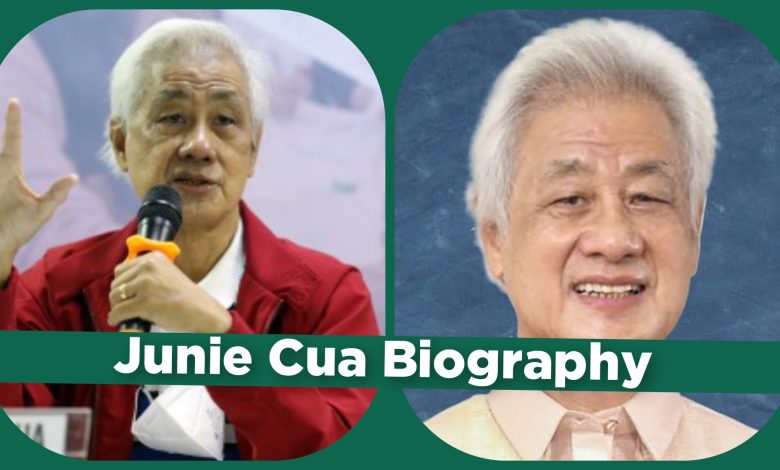
Junie Evangelista Cua is a Filipino public servant whose decades of work in politics and governance have shaped Quirino Province in the Cagayan Valley region of the Philippines. Born and raised with strong ties to this landlocked province in northeastern Luzon, he moved from business into elected office and later national roles, focusing on infrastructure, education and local progress.
His story reflects steady commitment to public service over many years. From representing Quirino in Congress across multiple terms to serving as governor and later as chairman of the Philippine Charity Sweepstakes Office, Junie Cua has remained closely linked to the development of his home province and the welfare of its people.
Junie Cua Early Life and Education
Junie Evangelista Cua was born on June 3, 1945. He is a native of Quirino Province in the Philippines. As the eldest in his family, he experienced the challenges common to many young people in rural areas during that era. He once accompanied his father to Zamboanga for studies and stayed there for about six months. The journey required crossing rivers and mountains, experiences that later influenced his strong support for accessible education.
He completed a Bachelor of Science in Business Administration at the University of the Philippines, graduating in 1967. Reports note the degree was earned with distinction. He continued with a Master of Business Administration from the same university in 1971. After graduation he briefly served as a professor at the UP College of Business Administration before leaving academic life to manage family business interests. In later years he completed postgraduate diplomas at Harvard University, one in leadership and development in 2003 and another in infrastructure and market economy in 2005.
These educational foundations prepared him for both private enterprise and eventual public service. Quirino Province itself is a landlocked area in the Cagayan Valley region of northeastern Luzon. It was established as a separate province in 1971, carved from parts of Nueva Vizcaya. The province features forested mountains, rivers that form part of the Cagayan River system, agricultural lands and growing tourism attractions such as caves and waterfalls. Cabarroguis serves as its capital. When Junie Cua first entered politics, the province ranked among the less developed areas in the region, with limited paved roads and basic services in many barangays.
Junie Cua Family and Personal Life
Junie Cua married Maria Angela Enriquez, his college classmate. She comes from a prominent family; her father served as a justice of the Court of Appeals. Maria Angela later served as a congresswoman. The couple raised several children, including Ligaya, Maria Dewata, Dakila Carlo, Maria Diwa, Carlo Isagani and Angelo. The older children attended the University of the Philippines while others studied at De La Salle University.
Their eldest son, Dakila Carlo “Dax” Enriquez Cua, followed his father into public service. He served as vice governor, governor and congressman of Quirino before returning as governor until his death on September 15, 2026, at the age of 48. Dax was married to Midy Nacague Cua, who has represented Quirino’s lone district in Congress. Junie Cua is also a grandfather to numerous grandchildren. Despite demanding schedules in business and government, accounts describe him as making time for family life.
Junie Cua Business Background Before Politics
Before entering elective office, Junie Cua built experience in private business. After teaching at the University of the Philippines he joined family enterprises and helped expand operations, including moves into export markets. This period developed practical skills in management, growth and economic opportunity that he later applied to provincial development. His business background informed his later focus on creating conditions for local enterprise, agriculture and infrastructure that could support livelihoods in Quirino.
Junie Cua Career in Public Service
Junie Cua entered politics in 1987, seeking to represent Quirino’s lone congressional district. He believed elective office offered the best way to serve the province and the country. He won the seat and served multiple terms in the House of Representatives: 1987 to 1998, 2001 to 2010, and 2019 to 2022. During these periods he chaired key committees, including the House Committee on Banks and Financial Intermediaries from 2019 to 2022, as well as committees on appropriations, good governance, and trade and industry in earlier terms. He authored or supported measures such as House Bill No. 6143 aimed at protecting consumers from financial fraud and misconduct.
Junie Cua as Governor of Quirino
From 2010 to 2019 Junie Cua served as governor of Quirino Province. He is widely recognized as the Architect of the Development of Quirino for transforming infrastructure and services. When he began legislative work the province had among the shortest stretches of concreted or asphalted roads in Region 2. Under his leadership and continued efforts, roads extended into remote barangays and sitios, improving access for farmers, students and residents. Education received sustained attention, reflecting his own early difficulties reaching school. Support for public schools, teachers and learners became a consistent priority.
Tourism and local economic initiatives also advanced. The province earned recognition including the National Calasag champion award, designation as a best tourism-oriented local government unit by the Department of Tourism, and status as the first ISO-certified province in Region 2. Quirino has repeatedly received the Seal of Good Local Governance. These outcomes grew from steady investment in roads, education, agriculture support and environmental care, including watershed protection given the province’s role as headwaters of the Cagayan River system.
Junie Cua National Appointments and Later Roles
Beyond elective posts, Junie Cua served as Presidential Assistant for Northern Luzon. In July 2022 he took his oath as chairman of the Philippine Charity Sweepstakes Office. In 2024 he was appointed chairperson of the John Hay Management Corporation Board of Directors. These roles extended his experience in governance, policy and institutional leadership at the national level. He did not seek elective office in the 2022 elections.
Throughout his career he maintained a focus on practical development rather than abstract policy alone. Walks to distant barangays early in his congressional service illustrated the physical challenges of connecting communities. Later projects addressed those gaps with concrete roads, school support and livelihood programs. Collaboration with national agencies and partners supported agricultural value chains, tourism and rural development initiatives that continued under subsequent provincial leadership.
Junie Cua Contributions to Quirino Province Development
Junie Cua’s work helped shift Quirino from a lower-class province with limited infrastructure toward stronger connectivity and human capital investment. Road networks expanded so that even upland areas gained better access. Education programs provided school supplies, infrastructure support and consistent provincial backing for the Department of Education. Agricultural and rural development efforts included farm-to-market roads, processing facilities and partnerships that improved farmer incomes.
Tourism promotion highlighted the province’s natural assets while environmental programs protected forests and watersheds. These combined efforts contributed to recognitions for good governance and tourism excellence. Residents and local officials have often described the changes as foundational, creating conditions for continued progress under later administrations, including that of his son Dakila Carlo Cua.
Junie Cua Awards and Recognitions
Specific individual awards for Junie Cua are less extensively documented in public sources than the recognitions earned by Quirino Province during and after his leadership. The province received the National Calasag champion award, Department of Tourism recognition as a best tourism-oriented local government unit, and first ISO certification among provinces in Region 2. Repeated Seal of Good Local Governance awards further reflected standards of transparency and service delivery advanced under his governorship and sustained afterward. His reputation as the Architect of the Development of Quirino remains the most frequently cited acknowledgment of his contributions.
Junie Cua Legacy and Continuing Influence
Junie Cua’s long service established patterns of infrastructure investment, education priority and practical governance that shaped Quirino’s modern path. Family members continued in public roles, extending aspects of that work. His son Dakila Carlo Cua served as governor until 2026 and advanced related priorities in roads, education and economic programs. Daughter-in-law Midy Cua has represented the province in Congress with stated commitment to education initiatives. National positions allowed Junie Cua to bring provincial perspectives into broader policy discussions.
His approach emphasized direct service and measurable improvements in daily life for residents. From early business experience to legislative and executive roles, the consistent thread has been development grounded in the realities of a once-isolated province. Quirino today shows the results of those decades of effort in improved roads, school support and recognition for local governance.
Conclusion
Junie Evangelista Cua’s life traces a path from rural educational challenges and private business to extended public service as congressman, governor and national official. Rooted in Quirino Province, he focused on roads, schools and practical progress that earned him recognition as a key figure in the province’s development. His family has continued aspects of that public involvement. The record of infrastructure gains, education support and institutional service offers a clear account of sustained local leadership over many years.
FAQs
Who is Junie Cua?
Junie Evangelista Cua is a Filipino politician and government official from Quirino Province. He has served as congressman for multiple terms, governor of Quirino from 2010 to 2019, and later as chairman of the Philippine Charity Sweepstakes Office.
When was Junie Cua born?
Junie Cua was born on June 3, 1945.
What is Junie Cua known for?
He is known as the Architect of the Development of Quirino for advancing roads, education and local services that transformed the province’s infrastructure and opportunities.
What positions has Junie Cua held?
He represented Quirino’s lone district in the House of Representatives across several periods, served as provincial governor, acted as Presidential Assistant for Northern Luzon, chaired the PCSO, and later chaired the John Hay Management Corporation Board.
Who is Junie Cua’s family?
He is married to former Congresswoman Maria Angela Enriquez-Cua. Their children include Dakila Carlo “Dax” Cua, who served as governor of Quirino until his death in 2026, and others. Midy Cua, wife of Dakila Carlo, has served as congresswoman for the province.
Where is Quirino Province?
Quirino is a landlocked province in the Cagayan Valley region of northeastern Luzon in the Philippines. Its capital is Cabarroguis. The province is known for forests, rivers and agricultural potential.
Did Junie Cua receive any awards?
Public records highlight awards earned by Quirino Province under his leadership, including tourism recognition, ISO certification and Seal of Good Local Governance distinctions, alongside his lasting reputation as a key developer of the province.